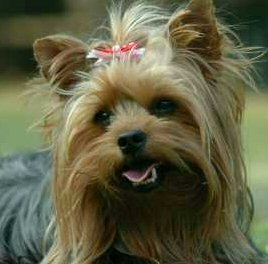
If you've never met a Yorkshire Terrier, then you've missed out on one of life's more entertaining experiences. These inquisitive little dogs are absolutely adorable. They usually top out at about 7 pounds, with some weighing a little more, and some a little less.
However; the only thing tiny about them is their structure. Their loyalty, personality, and courage will often top that of a 110 pound dog. Yorkies are exceptionally smart, and in spite of their small size, make excellent watch dogs. They must see a 100 pound image when they look in a mirror, because they'll seldom back down from anything. Their determination to protect their owner could indeed get them in a heap of trouble if they're not careful.
Your home is in good hands when there is a Yorki on board. The slightest noise awakens them and they're immediately ready to pursue the "invader".'
The origination of the Yorkshire Terrier is not entirely certain, but they are believed to have originated somewhere in England. They are part of the terrier group and it is believed they were used to hunts rats and other vermin--and yes, sometimes they like to dig.
Because Yorkies are tenacious little characters, they are sometimes accused of being difficult to train, but with perserverance and consistency, training should not be much of a problem. The earlier the training starts, the better. Yorkies need to know early in life what is and what is not acceptable behavior. They' re like small children, and will try to get away with as much as possible.
Yorkie puppies start out as adorable little fluffy black and tan furballs that mature into beautiful steel blue and tan adults with long silky coats. These beautiful coats however, take regular ongoing maintenance.
Many owners that have a Yorkie for companionship, and who don't intend to show the dog , opt to keep their dog in a shorter cut to alleviate some of this maintenance. This is an option that you may want to consider also unless you're willing to commit to considerable time maintaining your Yorkie.
Yorkie's are a very adaptable dog, and fit in well with a variety of different types of families from apartment tenants to country dwellers with large fenced in yards. They are extremely loyal to their owners and aim to please. They are very energetic, but are certainly not opposed to curling up in your lap for some love and personal attention.
Due to their small size they do better with older children if they're going to be around children at all. Because of the Yorkie's "big" attitude, we often forget that they're a small dog. Care must be taken when placing a Yorkie on a couch or bed or anyplace up off the floor. They will not hesitate to jump off and could quite possibly break a leg in doing so. A Yorkie may not be the perfect dog, but what they lack in some areas, they make up in personality, and are currently ranked in the top ten of most popular breeds.
Yorkshire Terrier Dog

A Glimpse on the Various Types of Terrier Dogs
Whatever your dog preference is, you are sure to find terrier dogs among the candidates for a pal. You’ll get energy you want with little grooming and added wit.
Basically bred for hunting and killing vermin, Terrier dogs are now known to offer wide spectrum of features and characters that you might find lovable. They are not as cuddly as toy dogs (while there are some terrier dogs in the toy and companion dog brackets) and they may not be as intelligent like other breeds but they set off these lacks with various things that only they can offer.
Let us discuss in brief some of the terrier dog types that you may find interesting:
Less aggressive but definitely not timid. This best describes Soft Coated Wheaten Terriers. They are definitely alert and very spirited, but when the call for steadiness arrives, they are sure to show you some air of confidence and steady disposition.
This dog type too is gifted with intelligence which makes them very responsive with obedience training.
Parson Russell Terrier is a dog type that exhibits boldness, cleverness, affection and exuberant disposition. While many may find this a playful pal, it is still not advisable for everyone to take Parson Russell home. In fact, formal obedience training is a must for owners since this dog type is more likely to display mischievousness and too much playfulness that make this a very independent pet. For people with active lifestyles and those who can tolerate explorative disposition, this scamp is the best for you.
The Norwich Terrier, on the other hand, is a type of dog that resulted from breeding small Terriers with other smaller breeds, possibly Yorkshire Terriers. Maintenance of Norwich Terrier is minimal and they are content with modest living quarters. They have active disposition though and can be affectionate and fearless. Additionally, they are also known to display stocky and happy personalities which make them ideal pals.
Much like the Norwich Terriers, Norfolk Terriers are also well-spirited, fearless, charming and always ready for game. While both may have some similar physical characteristics, Norfolks can still be distinguished through their folds in the ears.
Basically workman-like dogs, Kerry Blue Terriers are excellent watchdogs and work well in farm settings. This dog got its name from its blue-shade coat color which was originally black during puppyhood.
Wire Fox Terriers are of great interest since they display power through its excellent endurance capabilities and speed. Alertness and quick movements are the dominant expressions of this dog type. It is advisable though that the owner trains this dog and should be given enough doses of daily exercises.
Meanwhile, Smooth Fox Terriers are the frolic and lively types of dogs that are ideal in both country and city living. Displaying intelligence and cleverness, this dog makes good trainees and must be well credited by that. They are also likely to show great affection towards their owners.
These are just some of the many terrier dog types that can be considered as your next pets. In general, this dog type has good dispositions and makes ideal home pets. While some may display obscure aggressiveness, this still does not negate the fact that most types have the capacity to develop affection and keen expression of their attachment to their owners. Be warned though that some dog types in this breed can be very playful and should be given enough amount of attention and time during obedience training and exercises.
Some Terrier Dogs That You Would Find Interesting
The personality of a lively child put into dog- this might be a good way of describing the general personality of terriers. But as it appears, that still would not justify their temperaments.
These dogs came from the British Isles where they were first oriented to hunting fox, rat, otter and the likes over and under the ground. And as its name suggests, “terrier” came from the word “terra” which means, “earth”.
While terriers may be identified through their prominent physical characteristics, they are still divided into various breeds that separate one kind from another.
The following are the subgroups of the terrier breed:
Show Terriers- These are basically bred as small dogs and are used for show rings.
Bull and Terrier Types- these came from breeding between bull dogs and terriers. Only in the last quarter of 1800’s did the breeders separate a number of bull dogs from terrier types for distinction.
Hunting and Working Terriers- The breed that was primarily bred for hunting.
Toy Terriers- These are the smaller versions of terriers, which are basically categorized into the companion breed.
To help you understand the various natures of terrier dogs, we have prepared some dog profiles here, please read on.
Airedale Terrier- This is known to be the largest dog in the Terrier breed. Standing an average of 23 inches from the shoulder, this dog shows off both beauty and elegance that make them fit for both dog obedience trials and show rings.
A cross-breed between Otterhound and Black and Tan Terrier, Airedale possess good skill in scent and superb swimming prowess.
Australian Terrier- Probably one of the dog types that have gotten to so many out-crossings with other dog breeds. A cross breed between the forerunner of Dandie Dinmont and rough coated terrier is said to have been migrated into England. The offspring of which was taken to Australia. With the scarcity of dog breeds in this land, many dogs had been crossbred into it which later resulted to a small type having the characteristics of terriers while being a good watchdog and ratter. It stands 10 to 11 inches with a life expectancy of 12 to 14 years.
Border Terrier- A True-blue working terrier, this dog is marked by its medium built while proving to work far better than what its appearance may give. Border Terriers are agile and alert while having the capacity to fit into narrow gaps especially during hunting.
Aside from its being affectionate and good adaptation to training, Border terriers can also make good family pets.
Bull Terrier- Originally bred for dog fighting and bull baiting, this dog is known to have been well-accustomed to courage and good resistance to pain. However, when the bloody dog fights were banned in England during the 1800’s, most breeders turned to breeding milder dogs.
Bull Terriers came from these fighting dogs combined with Dalmatian and English Terrier to produce all-white specie. This new breed though is very much reserved from starting fights which gave them the nickname “White Cavalier”.
There are of course a variety of other terrier species. Initially, you might find them interesting enough to catch your attention but a closer look would lead you to further knowing them. Who knows, you might find your ideal type of dog in this breed.
A Dog in One Pack- Jack Russell Terrier
We basically want to find companions who would give us most of the benefits we think we need. Well, if you are looking for a dog that is somewhat a one-in-package pal, you might find Jack Russell Terriers interesting enough.
This dog has a history that is somehow loomed to give rise to the specie.
It was said that the breeder of this dog, a young Theologian student of Oxford University named John Russell once met a milkman with a white terrier that has spots on his eyes and ears. This dog became his interest which later proved to be his foundation for breeding a new dog breed that many has learned to love as pets. The dog he first saw was named "Trump" from which another 60 types of terriers were later bred from.
With a terrier's basic nature to go on and over the ground (terrier by the way came from the Latin term "terra" which means earth), Jack Russell terriers also have the disposition to hunt and scour for hunting. Thus, they should be given enough grooming so as to set off the dirt they gather from digging soil to either bury a treasure or to recover a hidden treasure kept long ago.
An excellent ratter, Jack Russell Terriers proves to be good "housekeepers" since they keep most rats away from home. Any unlucky rat that happens to be inside the quarters of this terrier is sure to meet its instant doom. Thus, owners find themselves with both a dog and cat in one pal.
One basic character of this dog is its disposition towards strangers. They can easily figure out who must be kept away from their homes and who can be accepted inside the house. This very attitude also makes them good watchdogs. They were designed specifically to be aggressive on preys. And while they can be very vocal, many of them only barks when they find good reason to.
They do not appear vicious though. But once they smell threat, they can show off aggressiveness that could serve as warning towards the strangers. However, once the stranger is let into the house by the owner, a Jack Russell can already tolerate his or her presence.
This terrier is also a family dog and desires for human companionship. And their love for children is significantly interesting. However, once they are abused or had been shown improper treatments, may it be intentional or accidental, they can react through aggressive behaviors. Their aggressiveness is further manifested with their lack of fear towards larger dogs which can unfortunately lead to injuries, some can even be fatal.
They are also marked for their intelligence and good spirit. These characteristics can be highly observable through their curiosity in things. Thus, they require supplementation on formal training unless you can tolerate difficult behaviors. The good thing though with Jack Russell is that it can acknowledge training and do well in most of them. In fact, they are known to champion various ring shows and other similar competitions.
The Hollywood has recognized the disposition of these dogs too. Coupled with feisty and good physical characteristics, this pal has already made names in the screens. If Wishbone, Milo (from The Mask) and Eddie (from the Frasier) ring the bell on you then there is no doubt that you can recognize this dog.
Jack Russell fair well with grooming. A dog of relatively small size, this breed will not tax you with grooming needs.

Caring for Your Soft Coated Wheaten Terrier Pet Dog
The soft coated wheaten terrier would be considered by most people to be “high maintenance”. This means that a lot of care should be given to it in order to maintain its stature. This statement also means that a lot of steps should be taken in order to care for the dog properly. So how do you care for your soft coated wheaten terrier pet dog?
Let us first talk about the coat. This is one of the most distinguishing characteristics of a soft coated wheaten terrier pet dog. In fact, when you take a look at the name, you will realize that the coat gives the dog its identity. Taking care of this essential part of the soft coated wheaten terrier dog can be quite a daunting task. This is especially true if you have just found out about the various standards that people use to judge the beauty of a soft coated wheaten terrier pet dog.
Frequent grooming is required to keep the coat shiny and to prevent matting. It also helps get rid of any accumulated dirt. You should comb or brush your soft coated wheaten terrier dog everyday to make sure that his coat remains silky and tangle-free. The coat also needs to be trimmed once in a while to preserve the “terrier look” and to allow a new coat to grow.
Besides the coat, you should also take care of the nails and teeth of your soft coated wheaten terrier pet dog. In case that you do not know what to do by yourself, you might want to hire some professional dog grooming services to do the job for you.
Another aspect you should concentrate on is the training. Remember to train your soft coated wheaten terrier dog as early as possible in order to ingrain in him the basics of proper behavior. There are several keywords that should come to your mind when training your soft coated wheaten terrier pet dog:
1) Consistency – be consistent with your teaching. Do not use different commands in order to get the same response as this will only serve to confuse your soft coated wheaten terrier pet dog. You should also be consistent in terms of reward and punishment. This will help your dog understand what you want to happen.
2) Tone – a soft coated wheaten terrier dog is actually pretty sensitive to the tones in the human voice. This means that the dog will be able to tell if you are feeling upset or if you are feeling impatient. You need to learn how to moderate your tone in order to avoid confusion with your soft coated wheaten terrier pet dog.
3) Timing –learn the proper timing of when to correct your soft coated wheaten terrier pet dog. The element you need during correction is surprise. You need to correct the soft coated wheaten terrier for a mistake right after or even before it performs the act. This way, you will be able to instill a sense of consequence into your soft coated wheaten terrier pet dog.
Caring and training for your soft coated wheaten terrier can be quite a bit of work. You will also have to contend with the energy inherent in every terrier breed. However, with patience, your efforts will be rewarded...

Unfortunate Impressions on Bull Dog Terriers
People might be wondering why there is such a name as "bull dog".
Originally, Great Britain and later, America were obsessed with bloody fights between bulls and dogs. The main function of the canine is to hang on to the bull's neck and worry the poor animal until it dies. Obviously, these dogs had developed great strength in their jaws.
Among the popular choices of dogs for this sport were the pit bulls. Back then, the selection of pit bulls was so varied that many showed a variety of characteristics that made the sport highly interesting. Later in the life of the sport though, the center of attraction switched towards the fight between pit bulls and not against the bulls themselves.
From these canines rooted most of the bull dog terriers that we know of today.
One of the significant bull dog terriers we have is the American Staffordshire Terrier who is of great interest since it possesses intriguing seemingly opposing characters.
They project strength and physically power but they are not vicious. In fact, this dog is very much associated with its relationship to its family, especially among children. The physical features it has are now only due to their basic nature and orientation during their bloody fights as fighting machines. But this does not negate the fact that they can sometimes show aggressiveness which may somehow work against them. Nevertheless, this can be set off with their loving nature and devotion to human family. Thus, it has a stable temperament which make them good pets and excellent watchdogs.
AmStaff terrier, as it is called by its shorter name suffers in reputation though since it is commonly associated with pit bulls. These dogs are known for their love for challnge and are therefore employed in illegal dog fighting.
Most of the problems root from irresponsible training. Sadly, there are too few AmStaff that are properly trained. And what's even depressing is that there are innumerable pit bulls that are continually ill-treated by sadistic owners.
We are often confused of what true pit bulls are. In fact, many contend that these dogs must not be called by that name since it elicits unwanted images of gory dog fights. While this breed is not yet officially recognized by the American Dog Breeders Association or the United Kennel Club, the legitimate name remains to be American Pit Bull Terrier.
While it is true that American Pit Bull Terrier is violent in nature, this doesn’t imply that they are made purely for brutal stuffs. As we have earlier said, these dogs are only products of maltreatment and exploitive training (and inhumane) for self serving purposes. Otherwise, American Pit Bull Terriers can be very people loving.
These are also known for their being hardworking on which they excel from. They are also fond of excessive physical activities that would exhaust their power reserves. Thus, this breed is great for those who need company during athletic training. If you are the couch potato personality, please find another breed of dog that would suit your lifestyle.
To clear things off, American Pit Bull Terrier are not officially recognized not because of its ill reputation but mainly due to beliefs that it is not a purebred. One major standard for a dog to be distinguished as member of Kennel Clubs is that it should be purebred. Until more comprehensive findings on its origin are found, this dog will remain unfortunately tagged as "nasty"...
The Loyal Working Companion Dog: American Pit Bull Terrier
This breed of dog, also fondly called as APBT, is known for its loyalty and intelligence. The dogs with this breed make excellent companions since they are very aggressive because of their protective nature.
How, then, are they different from the Staffies? For the UKC or the United Kennel Club, Staffies and APBT are of the same breed but many disapprove of this suggestion. For instance, if the American Kennel Club has an American Staffordshire terrier, it will be registered as an American pit bull terrier by the United Kennel Club. Furthermore, many breeders noted that their lineages have been separate for a long time already for these dogs to be still considered as having the same variety.
Meanwhile, the American Kennel Club does not register a UKC-listed American pit as an American Staffie. In order to gain dual-registry, the dog must initially be recorded as an AKC American Staffie before it can be listed with the UKC as an American pit bull, and not the other way around.
The following are some of the basic facts breeders would really love to know about APTBs:
Category: Terrier
Living Environment: either outdoor or indoor
Coat: smooth, shiny, thick, and short
Colors: color varies
Height: between 18 and 22 inches
Weight: between 30 and 60 pounds
Temperament: courageous, full of energy, and loyal; should be socialized early on with other animals especially with children
Health Issues: heart murmurs and mange
Care and Exercise:
• Bathe when necessary.
• Brush their coat only occasionally using a brush with firm bristles.
• Rub down their coat with a towel or a chamois to remove hairs that are loose.
• Their physique requires a regular exercise routine which includes a daily play time and/or running along a bicycle while on a leash.
• They should be on leash while walking in public places.
Origin/History:
The ancestors of APBT came to the US in the mid-1800s with some Irish-Boston immigrants. Like the Staffie, they were originally bred from bulldogs and terriers. Since APBT is a forerunner to the Staffie, it was also molded to be a fighting dog. However, the Americans made their variety some pounds heavier and trained them to have a more powerful head.
Bull baiting and dog baiting were prohibited in England so bull terriers were no longer bred for bouts. It is in America where the pit bull also gained its popularity for many uses and reasons like:
1. It was used to embody the country in one WW1 artwork.
2. Well-known companies like the Buster Brown Shoe Company and even RCA used the breed as mascots.
3. Petie, a pitbull, was one of the stars in, “Our Gang”, a well sought children’s TV series.
4. A mix breed called Stubby was transformed into a popular and decorated WW1 hero.
5. Pits became good companies of pioneer families on their journeys.
6. Jack, a working pit bulldog was owned by Laura Wilder of lines of books called “Little House”.
7. Popular people like Helen Keller and US President Theodore Roosevelt owned the variety.
Here is some history about the cause of dilemma regarding the registries of APBTs.
In 1898, the United Kennel Club or UKC was structured to provide fighting guidelines and registration for APBT as fighting dogs. Later, there were breeders who shun away from dog fighting so they asked the AKC to recognize their pits so they would be fit for performance events like dog shows.
In 1935, the AKC approved of their petitions but the dogs were registered as Staffordshire Terriers, naming them after the little province in England that the breed was known to have originated from. Thus, many breeders have dogs that have dual-registry.
It is interesting to note that Petie, which was one of the stars in the, “Our Gang” TV series was the first breed that was dual-registered to be Staffordshire Terrier/Pit Bull. However, the UKC later started registering other performing-type varieties and they also began holding dog shows comparable to those of the American Kennel Club.
The AKC soon sealed its studbooks to APBTs. They allocated registration to those pit breeds with lineages that are listed as Staffies. For a little time during the 1970s, the AKC disclosed the American pits to their studbooks.
In 1973, the American KC decided to add the word "American" with the pit’s name to discriminate it from a Staffie. At present, those dogs with mixed APTB-StaffIe parents are recognized by UKC and even the American Dog Breeders’ Association as “American pits or American pit bull terriers”.
Nowadays, the pit has employed as search and rescuers, police/armed service dogs, livestock workers, and even as therapy animals because they are good as companions and working dogs.
Moreover, the variety can even compete in dog sports such as herding, obedience, and conformation, French Ring, and Schutzhund. Breeds of this type can be very loving as pets for everyone. The physical demands and harshness of various activities developed a healthy, strong, and stable animal.
If you want to have an APBT as a pet, be sure that the puppy is handled well and properly socialized. A solid and good training will surely produce an obedient, tranquil, and good companion or even a working dog!

Some Facts on the Breed Temperament of Terrier Dogs
From the funny little pals to the more aggressive ones, terrier dogs definitely have wide spectrum of temperaments and dispositions that anyone would find interesting. In fact, any kind of owner would fit with the various characteristics that this breed can show. Beware though for some can be very mischievous while others can display timidity.
Terriers are primarily bred to help hunters in catching vermin, otter, foxes, rats and the likes. Newer breeds though tend to be so domesticated that they are now included in the companion and toy breeds.
As with many other dog breeds, terrier dogs have diverse characteristics that set one type from another. A number of owners find them as faithful in their families and are always ready to protect the home to which he has accustomed himself with. Distinguished excellent guardians, many dogs from this breed can easily determine well-intentioned strangers from those who mean harm...
This instinct to protect probably rooted from the earlier breeds which were originally used in bloody dog fights. Since the banning of this sport, many breeders resulted to producing more docile dogs for homes. Through innumerable cross-breedings, keen and protective terriers were produced.
Some notable terriers of this disposition are American Stafforshire Terrier or AmStaff, Airedale Terrier and Bedlington Terrier.
One of the major features terrier dogs have is their capability to respond well to training. In fact, some types are endowed with natural intelligence which makes them fit for obedience training and ring shows. Some terriers with this disposition need lots of activities that would challenge them mentally. Those included in this type must be given enough training so as to refrain them from being destructive out of boredom. Unlike larger breeds though with much intelligence, most terrier dogs will not make as much damage.
Some of this type also has the determination and dignified disposition that give them the air of confidence.
Some terrier dogs are fun loving and humorous in some sense. They are lively, frolic and gay which provide entertainment for their families and has become the favorites for many centuries.
Social terriers meanwhile should be given enough social environment so as to ready them as they mature. Most terriers with this disposition tend to dominate other dogs when they have come to their ideal age to assume authority. The bull terrier types could best display this temperament.
Surprisingly, some of the smallest terriers are among the toughest. Take the case of Cairn dogs. For their relatively small size and the stocky built, they still portray the disposition of being always ready when the need for activity arrives.
Many types of this breed though still retain the true terrier disposition. That is, hunting. Yet, significant with such dogs are their keenness to human companionship which make them both good ratters and affectionate pets.
Others still have the power, speed and endurance that many of their ancestors possessed. While some may be repressed due to domestication, many of them can manifest whenever the drives arise.
This breed is quite old. In fact, many of them had been existing since time immemorial. It's not surprising that they have various characters that an owner can either detest or love.
Some Facts about the Boston “Bull” Terrier Dog
The Boston terrier is a well-muscled and compact breed. This is not really surprising since the Boston terrier was first bred by people who wanted to use them in dog fights. Now some people may read all sorts of implications from such a violent past. Some people might think that the Boston terrier dog would make a bad pet because of its aggressive nature. However, you should know that as a pet, the Boston terrier can actually be pretty mild mannered.
The temperament of the Boston terrier can be described as enthusiastic as it often loves to play. Most people comment that the Boston terrier actually has a great sense of humor. Another characteristic that people find delightful with this breed is the fact that they are intelligent and are very much easily trained. This fact is also enhanced by the dog’s natural curiosity and love for learning.
Of course, people who own pets know the importance of training. Having a well-behaved pet increases the enjoyment for you both. Having a well-behaved pet means that you can have more fun with that pet.
One thing that owners have noticed with a Boston terrier is the fact that it can be very sensitive to the tone of a person’s voice. This may be described as a sort of emotion detector. Because of this sensitivity to the tone, a Boston terrier will be able to respond to how you are feeling when you are talking. This means, however, that you need to take care when training your dog. You need to make sure that anger and frustration do not find their way into your voice.
They also make excellent watchdogs as they do not bark indiscriminately. This means that you won’t wake up in the middle of the night because your Boston terrier saw a butterfly. There are some cases, though, when a Boston terrier will not bark at all.
Regarding the living conditions, Boston terriers can do well enough without a yard as long as they get regular exercise. This means that they are suitable for apartment living. However, you should also know that they are very sensitive to the extremes of weather. This means that you should keep it in a place that’s neither too hot nor too cold.
Unlike other terrier breeds, the Boston terrier is an average shedder. This means that you should be wary of keeping it indoors as it can shed fur over your floor. We all know how much of a fiasco that can be.
Bostons have a variety of common health problems. They easily get overheated when they are pushed too hard. As said before, they can also be sensitive to extreme weather and any weather that’s too hot or too cold can leave them with breathing difficulties. Skin tumors and heart tumors are very common with this breed. So you need to bring the dog to a vet regularly.
Another disorder you should watch out for is a skull defect. If a Boston terrier is badly bred, it often develops a bone defect that prevents the brain from growing. This, naturally, will lead to a retarded dog.
Some Information Regarding the Kerry Blue Terrier Pet Dog
The Blue Kerry terrier pet dog is one of the most mysterious breeds of terriers. This is because of the fact that even though the breed has been known by the Irish for at leas 150 years, nobody really knows where they came from or how they were first bred.
Various legends are told in order to explain the appearance of the Kerry blue terrier breed. Some say that the peasants bred them for hunting purposes since noblemen monopolized the use of wolfhounds. Thus, noblemen hunted with their wolfhounds while peasants poached with their Kerries.
Another legend speaks of a wrecked Russian ship that contained a blue dog. This dog swam into Irish shores and there, mated with the local terrier population. This, of course, started the genetic pool of blue Kerry terriers.
Whatever the case, the blue Kerry terrier sure has a colorful history. It started as a working dog, helping hunters bring in prey. It would also be trained as a police dog by the English. Today, it is considered to be one of the best breeds of dogs that one can own. This is in part of its excellent abilities as a watchdog.
One thing that is so cool about owning a Blue Kerry terrier pet dog is the fact that this breed is adaptable to every situation. It can be a hardworking hunter’s dog. It can become the vigilant watchdog. If you want companionship, it can also provide that. People who are fortunate to have a Blue Kerry terrier pet dog even say that once you are a Kerry lover, you are forever a Kerry lover.
There are some terrier characteristics which may cause a bit of trouble for your dog. Like all terriers, the Blue Kerry terrier pet dog can get into fights with other dogs. In order to prevent this, you need to make sure that the Blue Kerry terrier pet dog is properly socialized. Usually this is done by the breeder.
Most people, when they are getting a pet often ask the question of whether or not a pet can be housebroken easily. Thankfully enough, the Blue Kerry terrier pet dog has a disposition that is easily house trained. The Blue Kerry terrier pet dog is actually quite eager to learn. This means that you will be able to train it very quickly.
Although a Blue Kerry terrier can become an excellent playmate for children, it must be taken that the children do not show any cruelty to the dog.
The Blue Kerry terrier is also one of the more hardy types of terriers. This is because the Blue Kerry terrier has very few genetic problems. Before buying one, however, you need to ask for eye certifications and hip x-rays. These are the most commonly afflicted parts of the Blue Kerry terrier.
A Blue Kerry terrier is not really for everyone. Some people may find it a bit too playful. Some people may not really get used to the Blue Kerry terrier’s curiosity. People may not really understand its habit of following everyone around. Today, the fate of the Blue Kerry terrier dog lies in the hands of the breeders who care for them, nurture them, and make sure that they have great homes to stay in.


