Yikes! There’s a good chance your dog didn’t make the 10 Best List. Or, worse yet, made the Five Worst List. Not to worry! With a little help from you, your dog can be a canine ambassador—and attract new friends to you and to his breed.
If Your Dog Looks Scary
If you’ve got a big, brawny, scary-looking dog, soften his looks. The easiest, most effective way: a cool bandana around his neck. If he’s kind of a lovable goofball, maybe he wouldn’t even mind wearing a sun visor and sunglasses in summer. These tiny cosmetic changes have an enormous impact on how people view your dog.
If Your Dog Is Very Little or Looks Weird
Train your dog. People admire a dog who is very well trained—one who sits when you stop, does tricks, works on hand signals . Much of the resistance to very little dogs, very big dogs and oddlooking dogs is old-fashioned prejudice. These people decide they don’t like your dog without ever meeting him, and for no reason. What you’ll learn when you help people overcome this prejudice by showing off your well-trained dog is that the dog’s biggest detractors will turn into his biggest fans. They won’t just think he’s smart, they’ll think he’s the smartest dog in the world. And he’s not just friendly, he’s the most lovable dog in history. That’s the positive side of overcoming prejudice—it turns into adoration.
Carrying a Toy
Lots of dogs like to carry toys with them on walks. If you have a dog who looks scary or a little dog, you’d be amazed how people respond to the dog showing his teddy bear to everyone. (Of course, this only works if the dog likes to share his teddy bear. If he growls and stares balefully at the person admiring the toy, this isn’t good. Not good at all.)
Dogs Who Play Golf and Soccer
Here are some true stories about how people’s views about a dog change just by what he does. My dog Radar is a seven-pound Papillon—a little black and white dog with huge ears that look like butterfly wings. Although Radar has several obedience titles to his credit, men were mostly unimpressed by this butterfly dog. Until he
played golf.
A local television station decided to develop a fake commercial, in which viewers could supposedly buy “pup putts”—golfing gadgets that would improve your score. I trained Radar to grab a golf ball and drop it into the hole when I said, “Make par!”
During training (which I did on a putting practice area at a local golf course) and during filming, Radar’s golf game turned quite a few heads. This demographically desirable group of men—who would normally have been nonplussed by a dog who has been described as “a cat in drag”—were fascinated by the way he played their game. After one practice session, a man came up, looked at Radar in admiration, and said, “That is a great dog.” I knew a Pit Bull who always carried a soccer ball when he went
for walks. When kids (or attractive women) came up, the man who owned the dog would ask them to throw the dog’s ball. The dog would kick the ball back, and the dog and the woman would play soccer. Suddenly, instead of being a big, scary Pit Bull, this great dog was a fun soccer buddy.
Sports companies have said for years that the truly hip play sports. Apparently, if your dog plays sports, he’s viewed as more cool—and probably more human—than other dogs. Your dog doesn’t have to be the canine equivalent of Michael Jordan. Bring along a Frisbee or a tennis ball for him to chase and people will volunteer to throw it. When they experience the joy of playing fetch with a great dog, they forget to hate the dog.
If You Have a Poodle
Poodles of all three sizes (toy, miniature and standard) are handsome, athletic, intelligent dogs—and some of the most highly trainable animals in dogdom. What everyone makes fun of is the hairdo. There’s nothing in this world that says you have to decorate your Poodle with pompons. One of the most handsome dogs I’ve ever seen was a Standard Poodle whose coat was cut evenly all over, about half an inch long. This included the tail: no fancy pompon. The dog’s owner spent huge amounts of time convincing people this was really a Poodle. Groomed without frills, the dog looked more like the sporting dog this breed used to be.
The other alternative is to embrace the frills. There used to be a woman who jogged through my neighborhood with her black Standard Poodle. The dog was in full show coat: huge billows of hair on his head and chest, and shaved naked on his butt and legs (except for those decorative pompons). The woman who jogged with him always wore a black, fluffy, faux fur jacket that just came to her waist, and skin-tight black leggings. Yes, the dog and owner looked like they were wearing matching outfits. But they were both beautiful and athletic. People couldn’t help but stand still and watch them jog by with their elegant strides. In that instance, it worked to embrace the weirdness.
What to Do if the Dog You Love Isn’t on the List


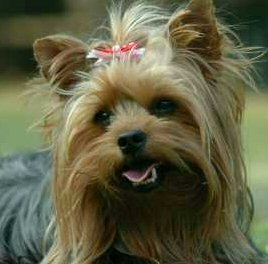
Yorkshire Terrier Dog
If you've never met a Yorkshire Terrier, then you've missed out on one of life's more entertaining experiences. These inquisitive little dogs are absolutely adorable. They usually top out at about 7 pounds, with some weighing a little more, and some a little less.
However; the only thing tiny about them is their structure. Their loyalty, personality, and courage will often top that of a 110 pound dog. Yorkies are exceptionally smart, and in spite of their small size, make excellent watch dogs. They must see a 100 pound image when they look in a mirror, because they'll seldom back down from anything. Their determination to protect their owner could indeed get them in a heap of trouble if they're not careful.
Your home is in good hands when there is a Yorki on board. The slightest noise awakens them and they're immediately ready to pursue the "invader".'
The origination of the Yorkshire Terrier is not entirely certain, but they are believed to have originated somewhere in England. They are part of the terrier group and it is believed they were used to hunts rats and other vermin--and yes, sometimes they like to dig.
Because Yorkies are tenacious little characters, they are sometimes accused of being difficult to train, but with perserverance and consistency, training should not be much of a problem. The earlier the training starts, the better. Yorkies need to know early in life what is and what is not acceptable behavior. They' re like small children, and will try to get away with as much as possible.
Yorkie puppies start out as adorable little fluffy black and tan furballs that mature into beautiful steel blue and tan adults with long silky coats. These beautiful coats however, take regular ongoing maintenance.
Many owners that have a Yorkie for companionship, and who don't intend to show the dog , opt to keep their dog in a shorter cut to alleviate some of this maintenance. This is an option that you may want to consider also unless you're willing to commit to considerable time maintaining your Yorkie.
Yorkie's are a very adaptable dog, and fit in well with a variety of different types of families from apartment tenants to country dwellers with large fenced in yards. They are extremely loyal to their owners and aim to please. They are very energetic, but are certainly not opposed to curling up in your lap for some love and personal attention.
Due to their small size they do better with older children if they're going to be around children at all. Because of the Yorkie's "big" attitude, we often forget that they're a small dog. Care must be taken when placing a Yorkie on a couch or bed or anyplace up off the floor. They will not hesitate to jump off and could quite possibly break a leg in doing so. A Yorkie may not be the perfect dog, but what they lack in some areas, they make up in personality, and are currently ranked in the top ten of most popular breeds.
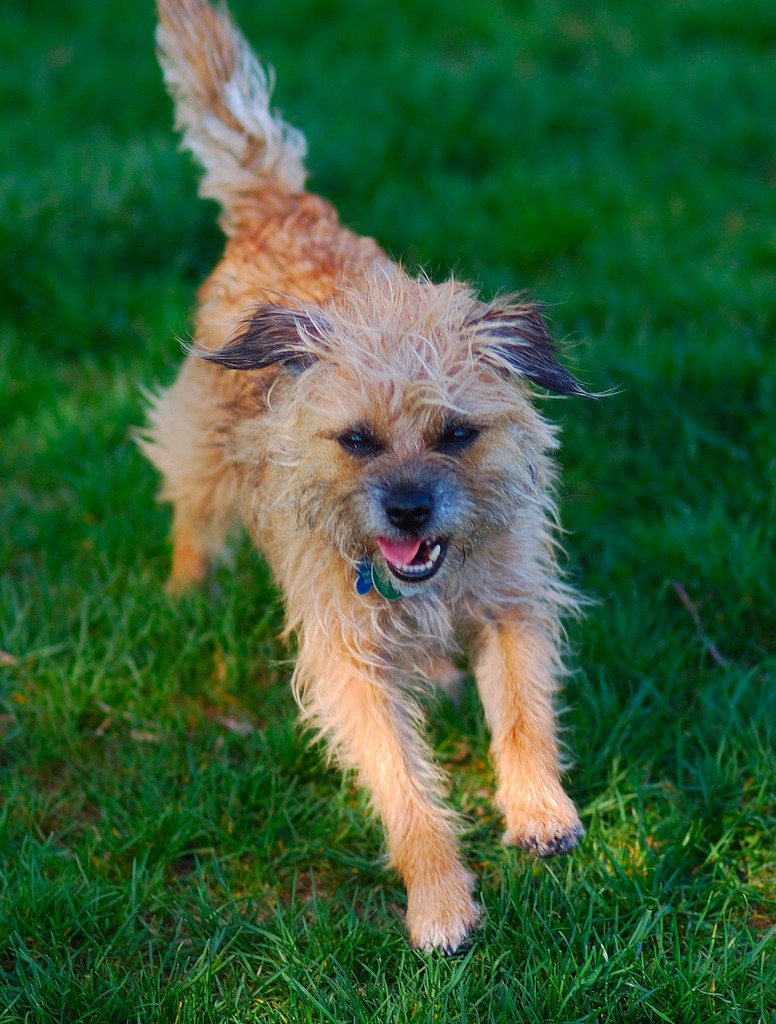
border terrier dog
The Border Terrier was originally bred in the Cheviot Hills area near the border between England and Scotland to help farmers drive predatory foxes from their dens and kill them. This sturdy little fellow has long enough legs and enough stamina to keep up with a horse, even though he is quite small. The bold little Border Terrier has also been used to hunt marten, otter and the fierce badger. As with most terriers, the Border Terrier gradually began to be taken into the home. Today due to his winning personality, adaptability and friendliness, the breed is highly esteemed as a companion dog, yet he can still serve as a fine farm dog, helping to control vermin. The Border Terrier was officially recognized by the British Kennel Club in 1920 and by the AKC in 1930. Some of the Border Terrier's talents include: hunting, tracking, watchdogging, agility, competitive obedience, and performing tricks.
The Border Terrier is small spunky terrier with a coarse, wiry double coat. He has dark lively eyes, a short muzzle, black nose and small ears, which fold forward into a "V" shape. The jaw should meet in a scissors bite. The tail is relatively short and tapers from a thicker base to the tip. It is carried level with the back unless the dog is very excited. Its limbs are not heavily boned. The Border Terrier comes in red, blue & tan, tan, and grizzle & tan. White on the feet is not allowed, but small patches of white are permissible on the chest.
The Border Terrier is alert and lively, but mild-mannered. Especially affectionate with children and wants to please, so it is relatively easy to train. A hardy, scruffy little terrier and a bold hunter. Socialize them well and get puppies accustomed to loud noises and city situations while they are still young to avoid excessive timidity. It will bark, but it is not aggressive. They might even go home with a burglar! Puppies are very active, but they will mellow as an adult. Border Terriers like to dig and must be securely fenced in. Many owners use free-standing dog runs or additional reinforcements along the bottom of their fences. They may get themselves stuck in tight holes, though they can usually wiggle their way out. They are not trustworthy with hamsters, rabbits, rats or birds, but will generally get along with other dogs. If the puppy is raised with cats, family cats will not generally be a problem. The dog shouldn't be trusted with other people's cats however. If you have two Border Terriers, it is best to have a male and a female. This breed does not do well when left alone all day. They are economical to feed, for they will thrive on a cup of dry dog food per day.